Epidemic spreading on networks and hypergraphs, and critical phenomena
Population dynamics, biological invasion, and mathematical oncology
Skyrmions, frustrated spin liquids, and 2D materials
500 CPU cores and over 3.4 TB RAM in 2 node groups, plus GPU workstations
Featured Research & Open Science
High-impact publications, open-source computational tools, and open datasets from GISC
Efficient Gillespie algorithms for spreading phenomena in large and heterogeneous higher-order networks
Hugo P. Maia, Wesley Cota, Yamir Moreno, Silvio C. Ferreira
Presents statistically exact, optimized continuous-time Gillespie algorithms for simulating spreading and contagion dynamics on large-scale higher-order hypergraphs, scaling to millions of nodes.
GISC - UFV (Zenodo)
Open datasets, benchmarks, and simulation output files associated with GISC publications.
gisc-ufv/hyperSIS
Statistically exact Optimized Gillespie Algorithm (OGA) for Susceptible-Infected-Susceptible (SIS) epidemic spreading on large and heterogeneous higher-order networks (hypergraphs), packaged via Fortran Package Manager (FPM).
wcota/dynSIS
Optimized Gillespie algorithms (SIS-OGA) for simulating Markovian epidemic processes on large and heterogeneous complex networks, with quasistationary analysis (Fortran / CPC 2017).
About GISC
The Complex Systems Research Group (GISC / Grupo de Investigação de Sistemas Complexos) was established at the Department of Physics of the Federal University of Viçosa (UFV), Minas Gerais, Brazil. In May 1992, GISC received its first research grant from FAPEMIG to investigate dynamic phase transitions in magnetic systems and cellular automata.
Over more than three decades of continuous scientific activity, GISC has grown into a recognized reference in statistical mechanics, non-linear dynamical systems, epidemic spreading processes, complex networks, biological physics, and magnetic nanostructures. Our multidisciplinary group brings together faculty professors, postdoctoral researchers, graduate students, and undergraduate researchers, seamlessly combining analytical theoretical methods with high-performance computational simulations.

Research Lines and Groups
Theoretical foundations, analytical modeling, and large-scale computational simulations
Complex Systems
Dynamic processes in complex networks
Analytical and computational modeling of spreading dynamics, epidemic thresholds on empirical networks, opinion formation, and critical phenomena.
Micro-rheology of viscoelastic materials
Multiscale Brownian dynamics elucidating macroscopic mechanical responses of hydrogels, collagen, and biological filaments from microscopic interactions.
Nucleation in disordered systems
Kinetic Monte Carlo simulations and non-equilibrium particle aggregation in biomolecular assemblies and quasicrystalline lattices.
Phase transitions in frustrated magnetic systems
Advanced Monte Carlo algorithms investigating phase transitions, thermodynamic properties, and ground states in low-dimensional frustrated systems.
Interface aggregation and growth phenomena
Scale analysis and kinetic growth modeling of self-organized nanostructures, epitaxial thin films, electrodeposition, and porous media.
Theoretical and Experimental Biological Physics
Population dynamics
Dynamical systems and cellular automata modeling agricultural pests, biological invasion via allelopathy, pheromone dispersion, and trophic webs.
Mathematical oncology
Multiscale stochastic cellular automata and reaction-diffusion models for avascular and vascular tumor growth and response to anticancer therapies.
Magnetic Systems and Nanostructured Magnetic Materials
Topological excitations in materials
Investigation of topologically protected defects, magnetic vortices, domain walls, skyrmions, and merons in low-dimensional nanostructures.
Topological States of Matter
Quantum Hall effects, 2D and 3D topological insulators, topological superconductors, and Majorana zero modes for quantum computation.
Magnetism and Nanomagnetism
Spin dynamics in low dimensions (from 0D to 3D), nanodisks, magnetic racetracks, and nanomagnetic manipulation for spintronics.
Frustrated magnetic systems
Spin liquids, artificial spin ice, fractionalized excitations, and emergent Nambu magnetic monopoles connected by energetic strings.
New Materials
Superconductors at high temperatures, graphene, and 2D van der Waals heterostructures supporting massless Dirac particles.
Investigation of devices by micromagnetic simulation
Micromagnetic simulations prototyping future spintronic devices, MRAM memory cells, logic transistors, and neuromorphic nano-oscillators.
Computational Infrastructure
GISC maintains high-performance scientific computing facilities divided between the Complex Systems Simulation Center (NSSC - Núcleo de Simulação de Sistemas Complexos) and the GISC terminal laboratory.


NSSC Simulation Center
Heavy parallel simulations & cluster computing

GISC Workstations
Room 218Dedicated GPU-accelerated computing & development
Equipped with modern multi-core processors, dedicated simulation GPUs (RTX 5090, RTX 4070 Ti, RTX 4060) and workstations for local researcher workflows.
Ibero-American School on Networks and Complex Systems
International event organized by GISC bringing together researchers and students across Latin America and the Iberian Peninsula.
GISC Research Community
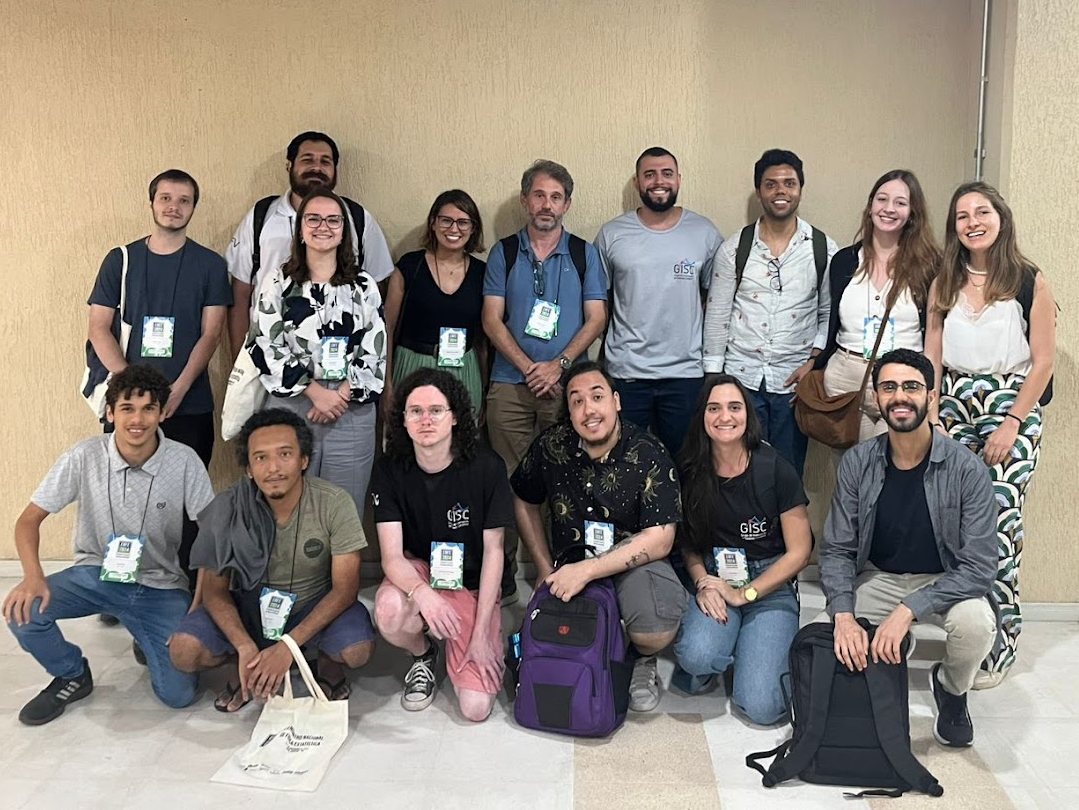
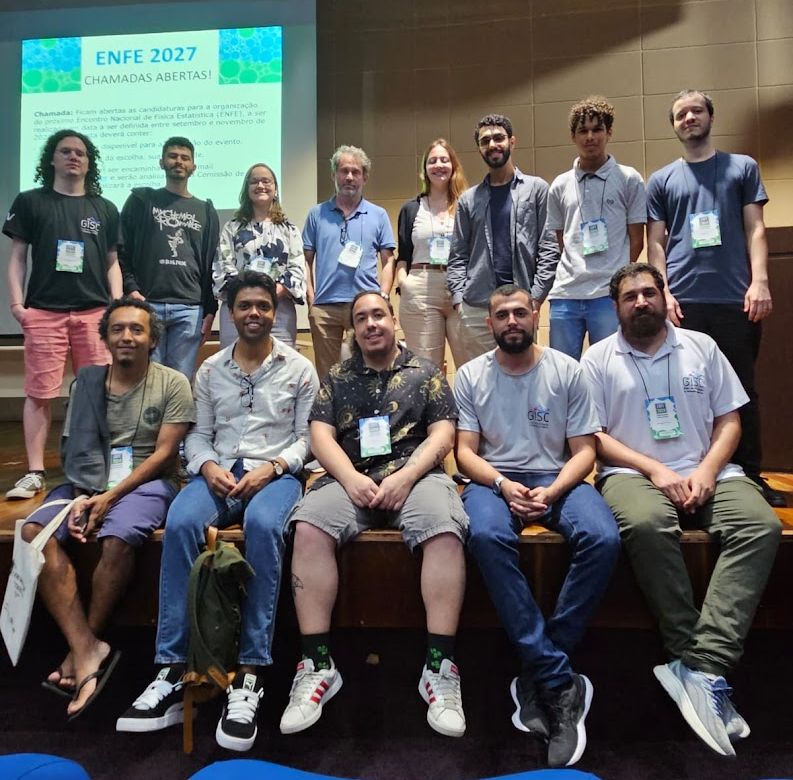
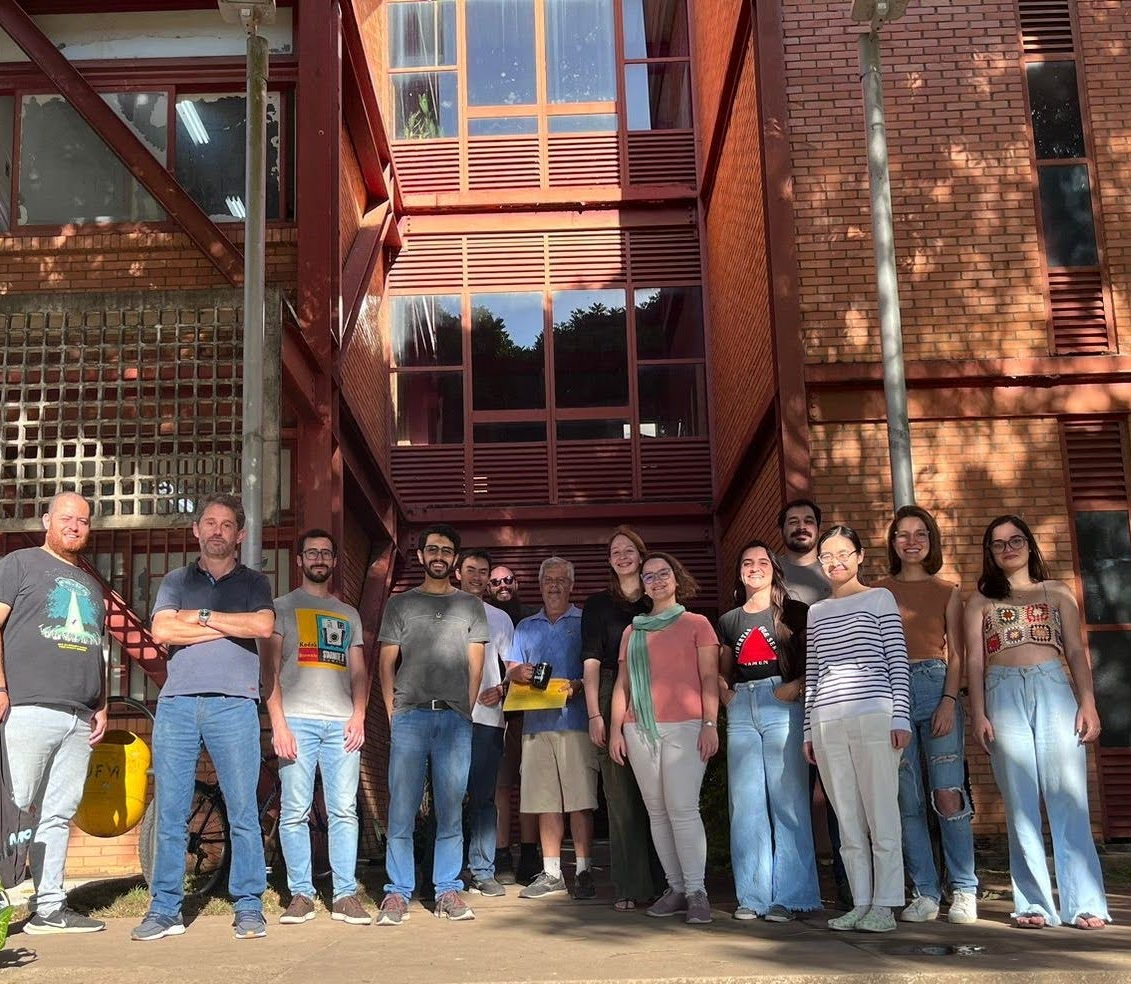
Faculty members, postdoctoral researchers, graduate students, and undergraduates at the Department of Physics (UFV).